Overview

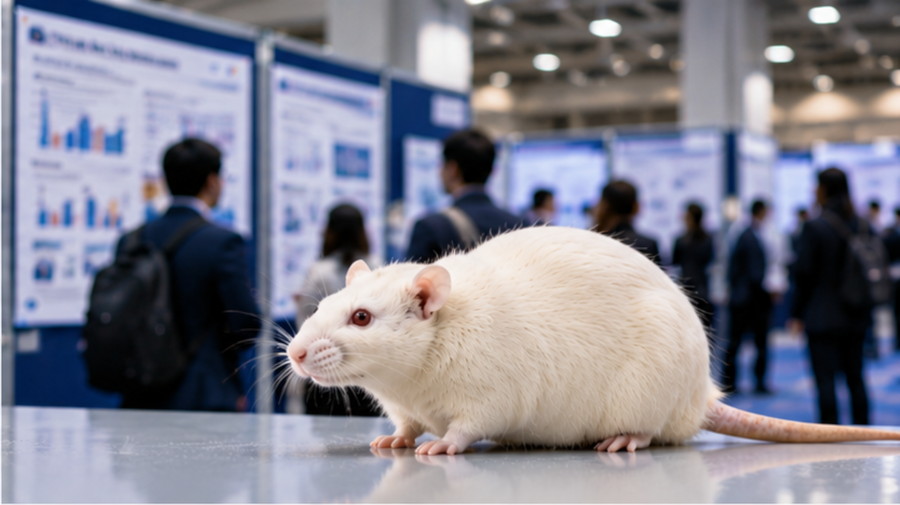
The SDT fatty rat is a spontaneous metabolic disease model that provides a relevant background for Cardio–Kidney–Metabolic (CKM) research.
Why It Matters for CKM
CKM disease is increasingly understood as an integrated continuum linking metabolic dysfunction, kidney disease, and cardiovascular pathology.
The SDT fatty rat provides:
- a spontaneous metabolic disease background, and
- a framework to evaluate cardiorenal progression under controlled conditions
Key Features
Early CKM Phenotype
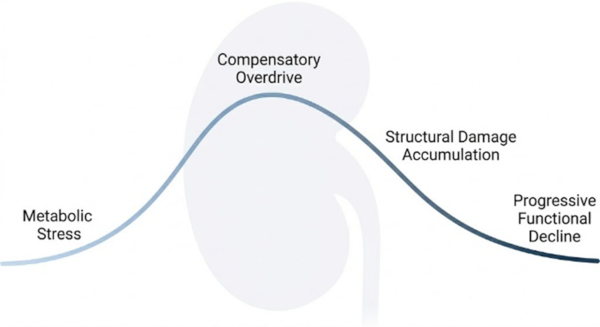
- Renal hyperfiltration emerges during the spontaneous metabolic phase
- HFpEF-like diastolic dysfunction is observed alongside preserved ejection fraction
These early changes reflect integrated cardiorenal stress relevant to CKM.
Supporting data:
Sano R, et al. (2021)
Glomerular hyperfiltration with hyperglycemia in the spontaneously diabetic Torii (SDT) fatty rat, an obese type 2 diabetic model.
Physiol Res. 2021; 70(1): 45-54.
Bollinger E, et al. (2025)
Restoration of branched chain amino acid catabolism improves kidney function in preclinical cardiovascular-kidney-metabolic syndrome models.
Kidney Int. 2025 May 21.
Pharmacological Responsiveness
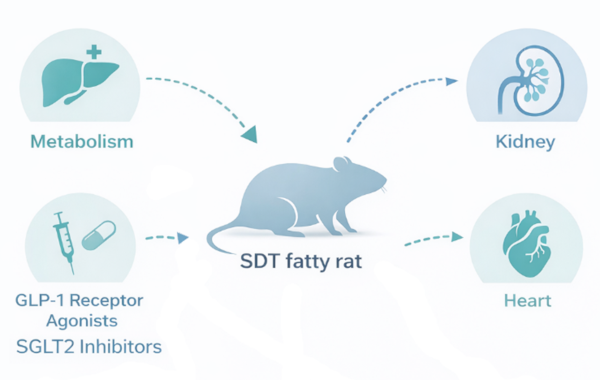
The model shows responsiveness to major CKM therapeutic classes:
- GLP-1 receptor agonists: improvement in metabolic and early cardiorenal parameters
- SGLT2 inhibitors: modulation of renal functional dynamics and albuminuria
Supporting data:
Explore GLP-1 study (liraglutide) → [PDF]
Explore SGLT2 study (dapagliflozin) → [PDF]
Shoji Takakura & Toshiyuki Takasu. (2019)
Acute and Direct Effects of Sodium-Glucose Cotransporter 2 Inhibition on Glomerular Filtration Rate in Spontaneously Diabetic Torii Fatty Rats.
Biol Pharm Bull. 2019; 42: 1707-1712.
GFR Dynamics (Key Interpretation)
- Hyperfiltration is observed under spontaneous metabolic conditions
- Progressive decline has been demonstrated in defined experimental settings
These findings represent complementary study contexts, not a single continuous dataset.
Renal decline observed under interventions such as unilateral nephrectomy should therefore be interpreted as:
experimentally accelerated progression on a disease-susceptible metabolic background
rather than a purely non-specific injury response.Supporting data:
See accelerated GFR decline study (UNx model) → [PDF]Y Shinozaki, et al. (2022)
Salt loading with unilateral nephrectomy accelerates decline in glomerular filtration rate in the hypertensive, obese, type 2 diabetic SDT fatty rat model of diabetic kidney disease.
Clin Exp Pharmacol Physiol. 2022; 49(4): 492-500.
Research Utility
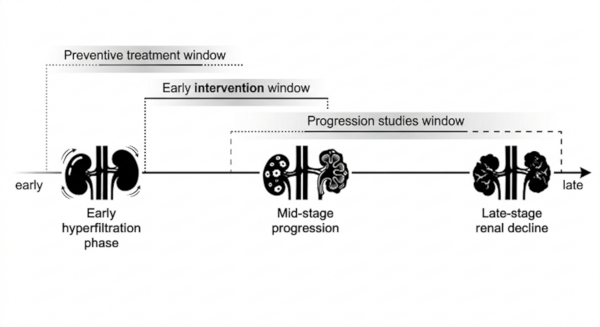
The SDT fatty rat enables
- integrated evaluation of metabolic, renal, and cardiac parameters
- early-stage intervention studies (hyperfiltration phase)
- controlled assessment of renal progression under defined conditions
- translational pharmacology of GLP-1 and SGLT2 therapies
Supporting data:
Yamada S, et al. (2021)
Renoprotective effect of GLP-1 receptor agonist, liraglutide, in early-phase diabetic kidney disease in spontaneously diabetic Torii fatty rats.
Clin Exp Nephrol. 2021 Apr; 25(4): 365-375.
Conclusion
The SDT fatty rat is best positioned as:
a spontaneous metabolic disease model with cardiorenal research utility, in which renal progression is evaluated under defined experimental conditions.
- biological relevance (spontaneous metabolic disease)
- experimental controllability (defined progression settings)
Featured International Scientific Presentations
1. NYAS CKD 2016
Key Finding:
An accelerated protocol induced substantial GFR decline within 10 weeks, accompanied by marked albuminuria, glomerulosclerosis, inflammation, and fibrosis.
2.Kidney Week (ASN) 2016
Key Finding:
SGLT2 inhibition improved metabolic parameters and blood pressure while modulating renal functional decline under defined experimental conditions.
3.ERA 2022
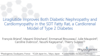
Key Finding:
GLP-1 receptor agonism improved both renal and cardiac parameters, supporting integrated cardiorenal therapeutic responsiveness.
https://www.clea-japan.com/promotion/reference_archive_en/sdt_fatty_rat_en
Contact
Masataka Tsubaki
CLEA Japan, Inc. – SDT Fatty Program
Tsubaki-m@clea-japan.com
or
For collaboration, joint studies, or model access, please contact CLEA Japan and our partner CROs using the inquiry form below.
Confidential discussion available upon request.