rasH2
Animals/Genetically Modified Animals/

Ordering name: rasH2
Nomenclature: CByB6F1-Tg(HRAS)2Jic
Common Name (Genotype): rasH2-Tg (tg/wt), rasH2-Wt (wt/wt)
Availability: Live colony
Genetically modified animal (subject to the Cartagena Protocol on Biosafety)
Characteristics
rasH2 is a short-term carcinogenesis study model mouse designed for rapid evaluation of tumorigenicity.
Tumorigenicity can be observed by 34 weeks of age. Carcinogenicity evaluation is conducted by starting administration of the test substance at 8 weeks of age and assessing tumorigenesis at 26 weeks.
Origin
CB6F1-TgrasH2 mice were created by Dr. Motoya Katsuki et al., with the support of Dr. Tatsuji Nomura, director of the Central Institute for Experimental Medicine and Life Science (CIEM).
In 1992, development of a carcinogenicity testing system using rasH2 mice began at CIEM.
From 1997 to 2000, high reproducibility and stability of carcinogenicity evaluations were validated through international collaborative research conducted in 50 industrial, governmental, and academic facilities across Europe, Japan, and the USA (ILSI/HESI).
Since 2001, CLEA Japan, Inc. has produced and supplied rasH2 mice.
Background Data (weight, blood property, blood biochemistry, organ weight)
- CByB6F1-Tg(HRAS)2Jic (tg/wt) 10 weeks of age data (*Japanese)

- CByB6F1-Tg(HRAS)2Jic (wt/wt) 10 weeks of age data (*Japanese)
- References

Detailed Catalog (PDF)
Model Overview & Key Carcinogenicity Data
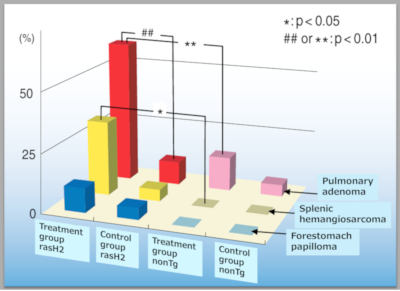
Key findings excerpted from the detailed catalog are shown below.
▼ Administration of a genotoxic carcinogen
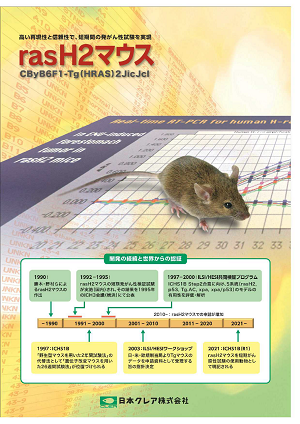
Download Detailed Study (Japanese)
▼ For more details (*Japanese) ▼
Our Contract Research Services related with This Animal
For details on our contract research services, including cryopreserved embryos, contracted testing, and the provision of research materials such as blood and organs, please click here .
FAQ
What is rasH2?
rasH2 is a short-term carcinogenesis study model mouse (CByB6F1-Tg(HRAS)2Jic) designed for rapid evaluation of tumorigenicity. It enables carcinogenicity testing within a shorter study period compared to conventional long-term models.
Is rasH2 a genetically modified animal?
Yes. rasH2 is a genetically modified animal and is subject to the Cartagena Protocol on Biosafety.
How long does a carcinogenicity study take using rasH2?
Tumorigenicity can be observed by 34 weeks of age. Carcinogenicity evaluation is conducted by starting administration of the test substance at 8 weeks of age and assessing tumorigenesis at 26 weeks.
Has rasH2 been internationally validated?
Yes. From 1997 to 2000, the reproducibility and stability of carcinogenicity evaluations using rasH2 mice were validated through international collaborative research conducted in 50 industrial, governmental, and academic facilities across Europe, Japan, and the USA (ILSI/HESI).
What genotypes are available for rasH2?
The common genotypes are rasH2-Tg (tg/wt) and rasH2-Wt (wt/wt). Availability is listed as Live colony.
Inquiry
▼ Please feel free to contact us